Most voice teachers will spend some time correcting or improving a students posture, not only for the positive effect good posture has on the appearance of the student when singing in public but, more importantly, to encourage the student to establish a skeletal frame alignment that best provides for efficient breath management.
I found that most students have inactive or poorly developed muscle systems in the core of the body between the shoulders and the pelvis. Inactivity of these muscles leads rather quickly to poor muscle tone and a general sense of dynamic “dullness” within the body core.
Dr. Barbara Doscher used a kinetic balance board on which the singer stood that corrected this problem. It was a 16 inch square cut from 3/4 inch plywood with the corners rounded to prevent hitting the ankles on the sharp edges or corners. The board was supported by two 4 X 4 X 2 inch blocks attached to the underside of the board along a center line perpendicular to two parallel sides of the board. The singer stood on the board and balanced so the edges of the 16 inch square board did not touch the floor. To achieve this required a very active body core and a strong sense of balance. The axis of the board could be side to side or front to back depending on the needs of the singer.
The act of balancing activated the body core muscles and improved posture. It was difficult to balance on the board if the singer slouched or hunched over. Only an erect posture made possible the act of balancing with the minimum of effort. That posture also required that the pelvis be positioned more forward than most students were used to; the pubic bone was more centered over the feet.
It was also possible to remove one of the 4 X 4 X 2 inch blocks and place the other block at the center of the bottom of the board so the singer could experience a balancing of not only side to side or front to back but balancing a whole 360 degrees.
The blocks were fastened to the board with 1/4 inch dowels which made removing the blocks and repositioning them quite simple.
Another configuration ofor building the board would look like this:
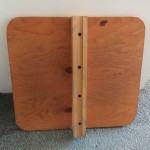
Bottom
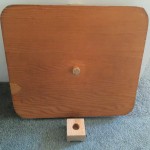
Top
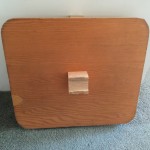
Top with Block
Board 16" x 16" x 3/4"; Rib 2 1/4" x 1 3/4" x 16"; Block 2 1/2" x 2 1/2" x 1 3/4"
The block is drilled to fasten to the dowel glued to the top of the board The board is then turned over when a single pivot point is desired. The Rib which is now the on top of the turned over board acts as a guide for balancing the single pivot configuration.
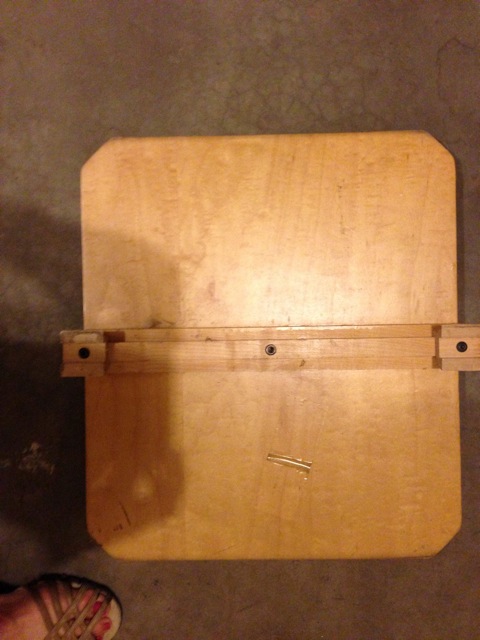
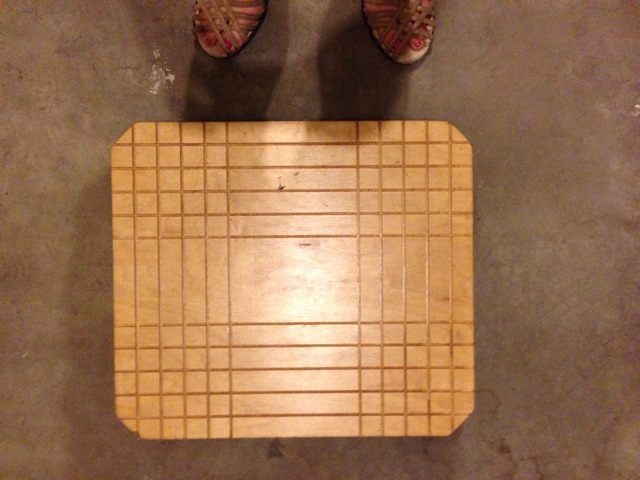
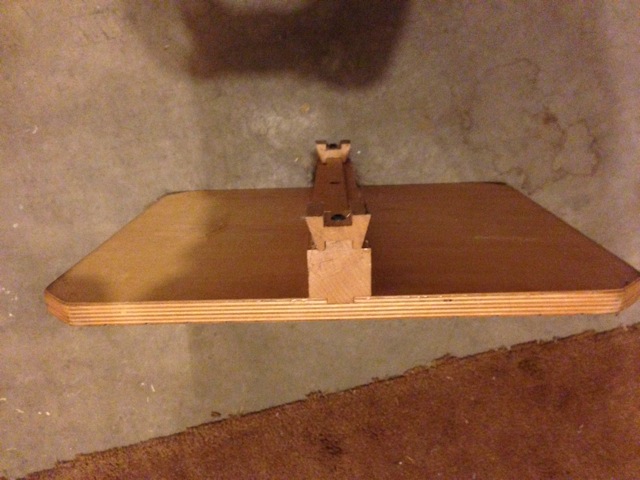
Below are three views of the commercially produced Balance Board. However, these boards can be easily made by following the descriptions given above and the home built models work very well. Once the singer is able to balance, only then is he or she encouraged to sing. Quite often the act of singing brings the singer out of balance, indicating that the singing posture was different from a well balanced more correct posture for good breath control.
Click on any of the photos for an enlarged version.
Dimensions below: Board 16" x 18" x 3/4"; Underside Rib 1 3/4" x 1 3/4" x 16";
2 Blocks 1 3/4" x 1 5/8" x 1" (height).
These blocks together with the Rib raises the board 2 1/2 " above the floor. The blocks can be removed to use just the Rib, which raises the board 1 1/2" above the floor. Or a single block can be fastened to the center of the rib raising the board the 2 1/2" above the floor but balancing the board on a single center point.